Clothing·6 min read
FiveM clothing: how add-on packs work, how to install them and how custom uniforms are made
Add-on instead of replace, components and props, the number that shifts, installing with a manifest and the two routes to custom clothing. Including the rigging mistakes that fail silently.
On a roleplay server, clothing is what players touch most often: every character gets dressed, every faction wants its own uniform, every streetwear shop wants pieces nobody else has. At the same time, clothing is the kind of content where most things go wrong, because GTA manages it differently from vehicles or interiors. This article explains the system, the installation and how custom pieces are made.
Add-on instead of replace
As with vehicles there are two routes. Replace overwrites an existing GTA piece: jacket number 12 then looks like yours, but every character who wore jacket 12 now wears yours. Add-on appends new pieces to the end of the list and leaves everything existing alone. For a server with saved characters replace is not an option: every overwritten piece retroactively changes the look of players who know nothing about it. Everything below is about add-on clothing.
How GTA manages clothing
Players on FiveM servers almost always use the two freemode characters from GTA Online, mp_m_freemode_01 and mp_f_freemode_01. Their body is split into components, each with a fixed number: 1 mask, 3 arms and torso, 4 legs, 5 bag, 6 shoes, 7 accessory, 8 undershirt, 9 vest, 10 decal, 11 jacket or top. On top come props that hang on the head or wrist: 0 hat, 1 glasses, 2 earring, 6 watch, 7 bracelet. Each component has a drawable (the model, say jacket number 12) and a texture (the colour variant of that jacket).
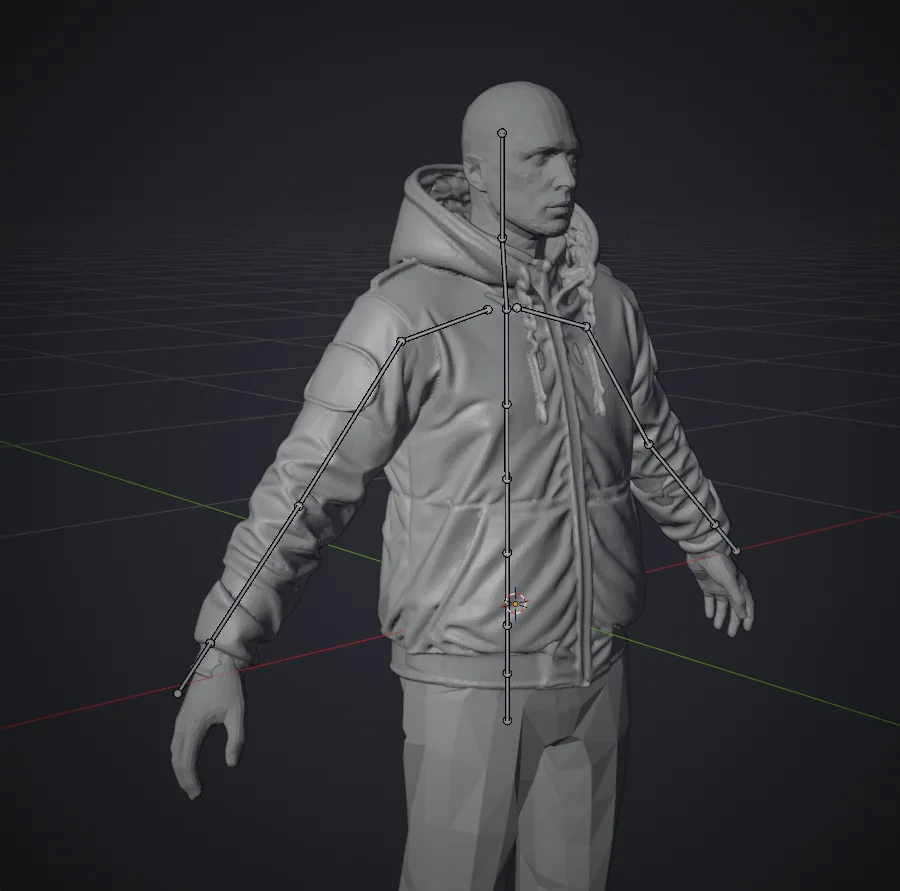
A piece of clothing is therefore not an object but a part of the character that moves with it. The model has to be bound to the freemode character's skeleton, bone by bone, so that a sleeve bends with the arm. That is why clothing is harder to build than a piece of furniture.
What is inside a clothing pack
- .ydd: the model of one piece, bound to the skeleton. One per drawable.
- .ytd: the textures, one file per colour variant.
- .ymt: the pack's list. It tells GTA how many drawables and textures exist per component. If it does not match the files, pieces are missing or the character turns invisible.
- A meta file that registers the pack with the game, via the fxmanifest.
fx_version 'cerulean'
game 'gta5'

files {
  'mp_m_5mcpolice.meta',
  'stream/mp_m_freemode_01_mp_m_5mcpolice.ymt',
}

data_file 'SHOP_PED_APPAREL_META_FILE' 'mp_m_5mcpolice.meta'
The file names follow a fixed pattern: character, pack name, component, number, variant. A jacket from our police pack is called mp_m_freemode_01_mp_m_5mcpolice^jbib_000_u.ydd, for instance, and its first texture mp_m_freemode_01_mp_m_5mcpolice^jbib_diff_000_a_uni.ytd. One letter wrong and GTA does not find the piece.
Installing it, and the number that shifts
Pack into the resources folder, ensure in server.cfg, restart. In the clothing menu or shop the new pieces appear at the end of the respective list. Men's and women's packs are separate; a piece for mp_m does not appear on mp_f.
Building custom clothing: two routes
Route 1: Blender and Sollumz
The classic route: bring an existing GTA piece into Blender as a base, lay your own model over it or rework the original, transfer the skeleton weights from the base piece to the new mesh, place textures on the UV layout, export as ydd and adjust the ymt. If you master this you can build anything. The learning curve is steep and the mistakes are quiet.
Route 2: 3D model and the Forge converter
Since usable AI model generators exist, a jacket comes into being as a 3D model in minutes instead of hours. What is then missing is the part that takes the most effort: rig, weights and GTA format. 5MC Forge takes an OBJ model, lays it on a GTA base piece, adopts its weights, generates ydd and ytd with the correct file names and adds the piece to the pack list. In the clothing studio you then see the piece on the character in motion: walking, running, crouching, aiming. That is where you find out whether a sleeve pokes through the jacket when the arm is raised.
Mistakes that fail silently
- Pieces deform while walking or stay floating in the air: the weights are wrong or missing. Every vertex of the mesh has to be bound to the right bones, with the same values as the base piece underneath.
- The lining pokes through the fabric: inner surfaces of the model sit too close to the outer skin. Remove inner faces or offset them inwards.
- The texture looks smeared: UV islands overlap. GTA then paints two spots of the model with the same part of the image.
- The piece is invisible but the character is there: the ymt counts more drawables than files exist, or the file name deviates from the pattern.
- The piece appears on men but not on women: there is no mp_f counterpart. Both characters share the skeleton but not the body shape; every piece needs a version per body.
- The server stutters since the pack went in: too many polygons or 4K textures for a T-shirt. 1K is enough for almost everything, 2K for pieces with fine print.
Uniforms for factions
A uniform is a combination of pieces that a faction system puts on at the start of duty and swaps back for personal clothing at the end: top, trousers, shoes, vest, badge, often different per rank. For that to work reliably the system must know the pieces by pack and number within the pack (see above) and store them separately for men and women. With 5MCustoms the team defines duty clothing in the admin menu by wearing it and saving it; members receive it at the locker room of their station.
Clothing from 5MCustoms
The shop has clothing packs for factions and streetwear as finished add-on resources, for men and women, and made-to-order pieces from 10 euros each via the cost estimate: your logo on the vest, your colours on the jacket, a brand new piece from a sketch. Everything is built in Forge and checked on the moving character before delivery. More in the FiveM clothing guide in the shop.
Frequently asked questions
Do I need a script for add-on clothing?
No. A clothing pack consists only of models, textures and two lists. You only need a script to sell the pieces in a shop or assign them as a uniform.
Why are my uniforms wrong after an update?
Because a new pack was added or the load order changed. The add-on piece numbers shifted as a result. Store uniforms by pack name and number within the pack and it will not happen again.
Can I use clothing from GTA5-Mods.com?
Many of those pieces are replace files for singleplayer and overwrite existing clothing on a server. Add-on packs from there work if the ymt is correct and the creator's licence allows it. Pieces with real brand logos do not belong on a public server.
How many clothing packs can a server handle?
GTA has a limit on the number of drawables per component that very large collections reach; before that, streaming memory usually makes itself felt. Clean packs with 1K textures run by the dozen. Whatever nobody wears goes out.
Related products
Founder of 5MCustoms
Justin has been building FiveM servers, vehicles and scripts for years. 5MCustoms is the framework that grew out of it. What you read here comes from practice, not from a product sheet.
Keep reading
All articles
Server setup·1 October 2026
Detecting cheaters on your FiveM server: how to spot them and what actually works against them
Which mod menus exist, which traces they leave, why client-side checks are useless and how a server-side anti-cheat decides. With a checklist for the first evening after opening.
5 min read
Server setup·1 October 2026
FiveM server optimization: why it stutters and how to find the cause in an hour
Server tick, client FPS and streaming are three different problems with three different tools. How to find the culprit with resmon, the profiler and txAdmin, and the ten causes that are almost always behind it.
5 min read

Server setup·1 October 2026
What a FiveM server really costs: three budgets for three kinds of server
Hosting, framework, scripts, vehicles, Discord, domain and the items nobody thinks of. Three worked examples from a friends-only server to a whitelist project, with what really adds up in the first year.
5 min read